Rating Methodology
Since 2020, RREDA has been conducting regular comprehensive analyses of the investment climate of the regions of the Russian Federation in the field of renewable energy in order to compile a regional rating.
Given the specific structure of the Russian Federation's electric power system, ratings for the period from 2020 to 2024 were compiled separately for regions in the price zones of the wholesale electricity and capacity market (WECM) and for regions in the non-price zones, together with regions classified as technologically isolated territorial power systems.
Starting in 2025, following structural changes in the wholesale electricity and capacity market, the ratings are compiled simultaneously for all regions of Russia.
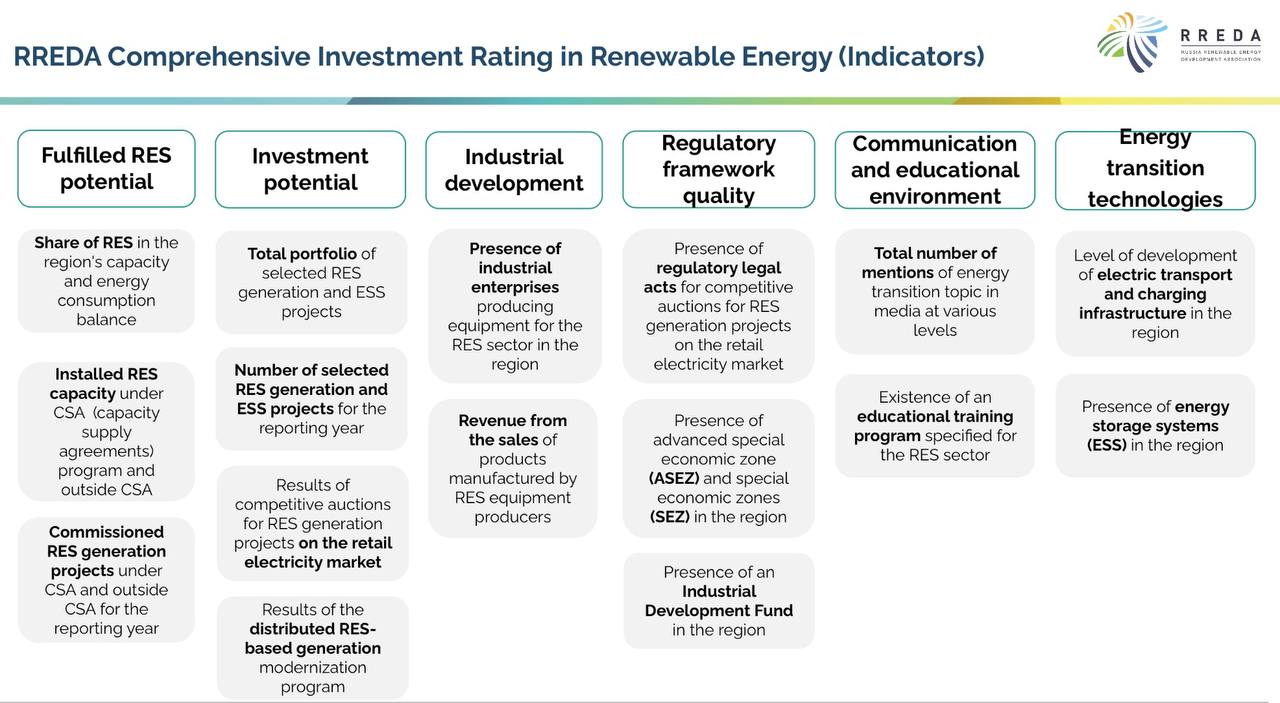
As part of the work on compiling the ratings, RREDA conducts a comprehensive assessment of the status and development prospects of renewable energy across the federal subjects (regions) of the Russian Federation. RREDA experts analyze up-to-date statistics from Rosstat and federal agencies, data from open sources and official documents, and aggregate this information into calculated indicators. The assessment uses a set of indicators that can be divided into six groups:
- Fulfilled RES potential
- Investment potential
- Industrial development
- Regulatory framework quality
- Communication and educational environment
- Energy transition technologies
Fulfilled RES potential: assesses actual volumes of RES generation (installed capacity, capacity commissioned during the reporting period) and their share in the region's energy balance.
Investment potential: assesses the portfolio of selected RES generation and ESS (energy storage system) projects, the results of competitive auctions for RES generation projects on the retail electricity market, and the results of the distributed RES-based generation modernization program.
Industrial development: assesses the region's industrial base for renewable energy (volume of equipment output, presence of manufacturing facilities, and investment in production).
Regulatory framework quality: assesses the quality of regional regulation — the presence of regulatory legal acts for competitive auctions for RES generation projects on the retail electricity market, special economic zones (SEZ), advanced special economic zones (ASEZ), and a regional Industrial Development Fund (IDF).
Communication and educational environment: assesses the region's efforts to promote renewable energy in the media space and in education (mentions in the media, activity on government websites, and the availability of educational programs for training personnel for the RES sector).
Energy transition technologies: assesses the region's initiatives in adjacent energy transition technology segments (electric transport and charging infrastructure, energy storage systems).
For the purposes of compiling the rating, all indicators are assigned a weight based on an expert assessment of their significance in terms of their impact on the region's investment attractiveness.